
From Production to Provocation
Despite what you might have read, design is not dead—evolving for sure, but most certainly not dying.
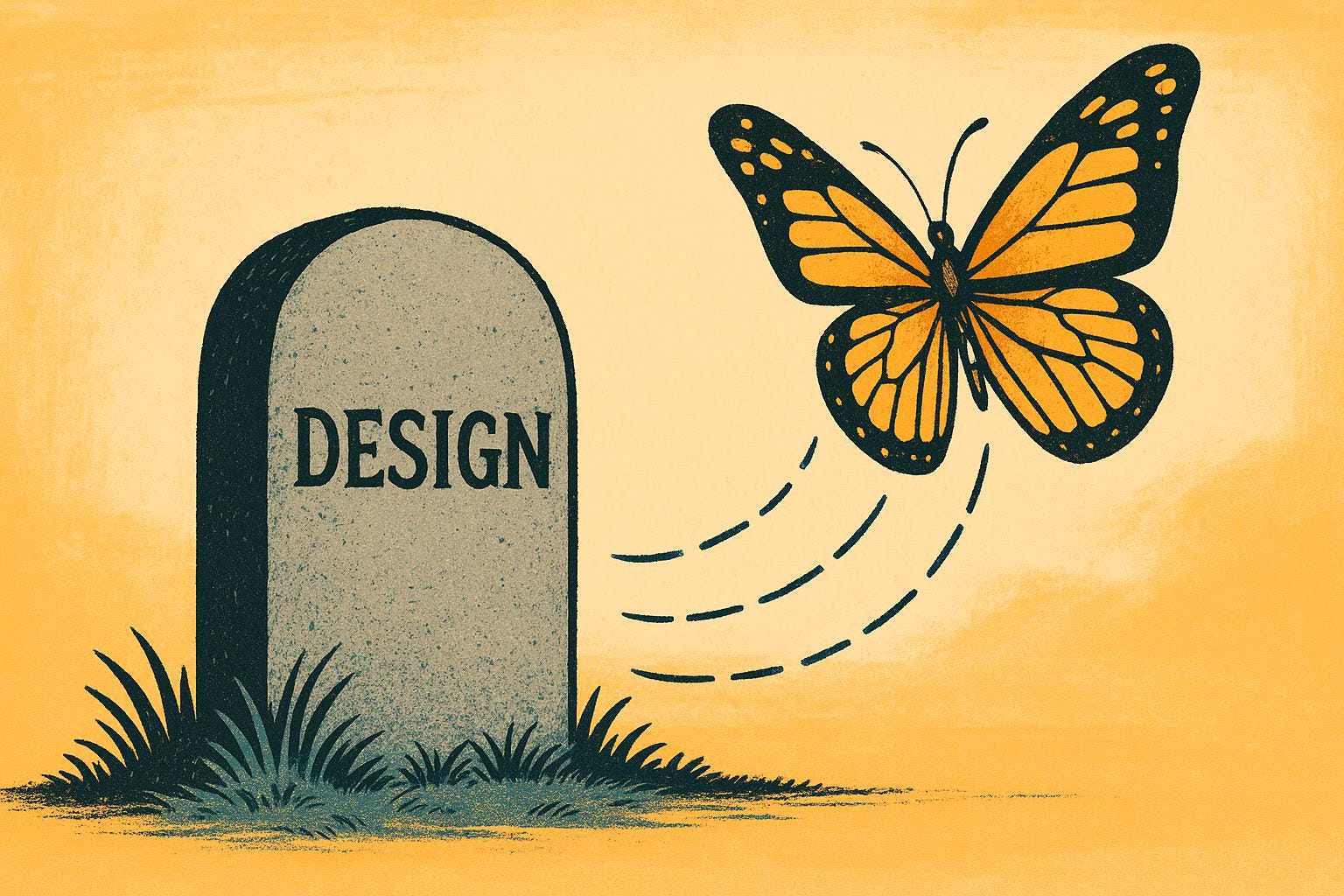
Despite what you might have read, design is not dead—evolving for sure, but most certainly not dying.
Looking into my admittedly cloudy crystal ball, I don’t see a tombstone so much as I see a future where design teams simultaneously get much smaller while also becoming far more influential—as paradoxical as that sounds.
My read is that we’re rapidly moving to a job market where the most valuable and sought-after skills are less about tactical production (Figma, prototyping, coding, etc.) and more about carbon-based competencies like communication, conceptual positioning, and original thinking. If that trend holds, designers need to emphasize and hone their skills involving:
Pitching and storytelling
Facilitating structured, cross-functional ideation workshops
Originating, guiding, and giving visible form to “zero to one” initiatives
Imagining bold and innovative new ways to position software capabilities into the user’s existing conceptual framework
In essence, Design needs to “move up the stack,” originating and driving feature ideas that anticipate user needs rather than simply reacting to them.
For better or worse, we’re already at a place where many PMs and engineers can take their own ideas from concept to reasonably competent UI without traditional design input. However, it’s important to keep in mind that the ideas that emerge from that dynamic tend to focus more on filling obvious feature gaps or responding to direct customer requests rather than on delivering original, precedent-setting products or experiences. And to be clear, I’m not saying that filling feature gaps and delivering on customer requests aren’t critical to product success. Rather my point is that, in and of themselves, they’re not enough to sustain competitive advantage or long-term user engagement.
The current opportunity for Design is to find ways to work outside of the existing “feature machine” so we can focus on the deeply transformative ideas that are going to make a lasting difference. We need to employ all of our skills and talents to bring to life products and experiences users have never asked for and can’t readily imagine, but love and desire once they see them. Fortunately, many design teams are already in possession of the tools, techniques, methods, and mindsets required to do that so the challenge is not so much about adding new capabilities as it about proving to our colleagues that we can do more — a LOT more.
There’s nothing easy or automatic about original thinking. It’s the highest bar and the hardest thing you can do as a creative professional. However, we all need to push ourselves to get there because we’re sitting on a generational opportunity.
The question isn’t whether Design is dead. It’s whether Design is ready to seize the moment and prove that we have the skills, the methods, and the mindset to produce bold, meaningful, game-changing ideas.
###